
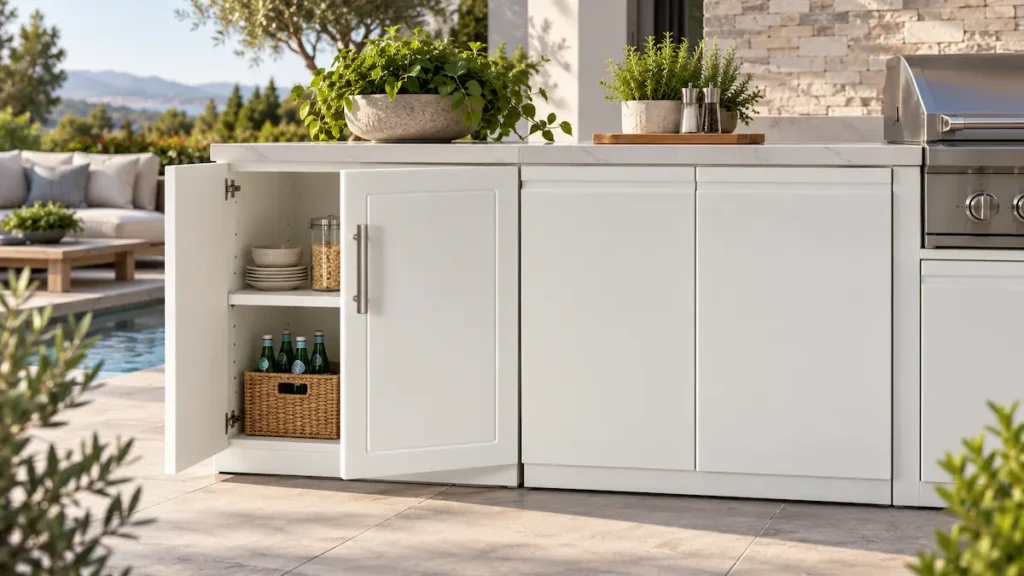
HDPE outdoor furniture is becoming increasingly popular for applications that must withstand sunlight, rain, humidity, temperature changes and long-term outdoor exposure. Unlike indoor furniture, outdoor products require materials that can maintain their appearance and performance in much more demanding environments.
For decades, wood and metal have been among the most common materials used for outdoor furniture. Today, however, high-density polyethylene (HDPE) is becoming increasingly visible across a much wider range of outdoor products.
And this trend is not limited to Adirondack chairs or patio seating.
HDPE is now being used for dining furniture, benches, tables, storage cabinets, outdoor kitchen cabinetry, lockers, shelving systems and other functional outdoor furniture where moisture resistance, low maintenance and manufacturing flexibility are important.
So why is HDPE attracting more attention in outdoor furniture applications?
What Is HDPE Outdoor Furniture?
HDPE stands for High-Density Polyethylene, a thermoplastic material widely used in industrial and commercial applications where durability, moisture resistance and chemical resistance are important.
For furniture manufacturing, HDPE can be produced as sheets, boards or lumber-like profiles. These materials can then be cut, CNC machined, drilled, routed and finished into individual components before being assembled into a finished product.
Depending on the design, these components may become chair backs and armrests, table surfaces, cabinet doors, shelves, side panels, storage compartments or structural elements.
This manufacturing flexibility is one of the reasons HDPE has moved beyond simple plastic seating and into more sophisticated outdoor furniture systems.
Terms such as HDPE furniture, HDPE poly lumber, plastic lumber furniture and HDPE outdoor cabinetry are therefore becoming increasingly relevant across different parts of the outdoor furniture market.
Why Is HDPE Well Suited to Outdoor Environments?
The appeal of HDPE starts with the environment itself.
Outdoor furniture may be exposed to rain, irrigation, humidity, sunlight, pool water, cleaning chemicals and repeated temperature changes. In many applications, the material must continue performing without the level of maintenance normally associated with natural materials.
Moisture Resistance
HDPE has very low water absorption.
Unlike wood, it does not depend on a coating or sealant to prevent the material itself from absorbing moisture and eventually rotting.
This makes HDPE particularly interesting for furniture used around gardens, swimming pools, patios, coastal areas and other locations where water exposure is unavoidable.
Moisture resistance is also one reason HDPE can be attractive for products such as outdoor storage cabinets and outdoor kitchen cabinetry, where panels, doors and shelves may remain outdoors throughout the year.
Weather and UV Resistance
Sunlight can affect almost every material used outdoors.
HDPE intended for long-term outdoor applications can be formulated with appropriate pigments and UV stabilizers to improve resistance to weathering and color degradation.
That distinction is important.
Not every HDPE material performs the same way outdoors. Long-term performance depends on factors such as material formulation, UV stabilization, pigment quality, manufacturing control and the actual environment in which the product is used.
For this reason, simply specifying “HDPE” does not fully define the expected performance of an outdoor furniture product.
Low Maintenance
Maintenance is another major reason HDPE is attractive in outdoor applications.
Depending on the species and finish, wooden furniture may require periodic painting, staining, sealing or refinishing.
HDPE generally requires much less routine surface maintenance. Normal outdoor dirt can usually be cleaned without repainting or resealing the material itself.
That matters not only for residential patio furniture, but also for hotels, restaurants, resorts, swimming pools, parks and commercial facilities where maintaining large numbers of outdoor products can become a significant operational task.
No Rot or Splintering
HDPE does not rot and does not develop wooden splinters.
For seating products, this is useful on surfaces people frequently touch, such as chair arms, benches and table edges.
For cabinets and storage systems, the same property is useful on doors, shelves, handles and exposed edges that may be repeatedly opened, cleaned or contacted during use.
Machined edges can also be rounded and finished directly in the material without exposing a different untreated substrate beneath a surface coating.
Color Throughout the Material
Another useful characteristic is that color can be incorporated throughout an HDPE sheet or profile rather than being applied only as paint on the surface.
This gives furniture designers more freedom to work with different color combinations while reducing reliance on surface coatings.
For products exposed to frequent use, this can also make normal scratches and edge wear less visually obvious than on a coated material where damage may reveal a different substrate beneath the finish.
HDPE Outdoor Furniture Is More Than Chairs
One of the easiest mistakes to make when discussing HDPE furniture is to think only about patio chairs.
Adirondack chairs are certainly one of the most recognizable HDPE products, but the material is now being used across a much broader furniture range.
For seating and leisure applications, HDPE can be used in dining chairs, rocking chairs, benches, chaise lounges and outdoor sofas.
For outdoor dining areas, it can be used for dining tables, bar tables, side tables and coffee tables.
But one of the more interesting areas is storage and functional outdoor furniture.
HDPE sheets can be fabricated into outdoor storage cabinets, poolside storage units, garden storage systems, lockers, shelving, utility cabinets and outdoor kitchen components.
These applications make particularly good use of sheet-based fabrication because large panels can be CNC cut and machined into doors, shelves, side walls and structural parts before final assembly.
As a result, HDPE is increasingly relevant not only to traditional furniture manufacturers, but also to companies working in outdoor storage, commercial facilities and functional outdoor equipment.
HDPE Furniture Is Not the Same as Lightweight Plastic Furniture
The word “plastic” can sometimes create the wrong impression.
Many inexpensive plastic chairs are produced as lightweight, thin-wall injection-molded products.
HDPE sheet- or lumber-based furniture can use a very different manufacturing approach.
The material can move through a process such as:
sheet or profile → cutting → CNC machining → drilling → edge finishing → hardware installation → assembly
This means individual furniture parts can be designed separately and manufactured with controlled dimensions.
For a chair, those parts may include the seat, back, arms and legs.
For a cabinet, they may include the doors, side panels, shelves, base, top and internal dividers.
For a table, they may include the top, frame components and supporting structures.
This modular manufacturing approach also creates possibilities for different edge profiles, CNC patterns, engraved details, drainage features and customized geometries.
We will look at these manufacturing methods in more detail later in this series.
How Does HDPE Compare with Traditional Outdoor Furniture Materials?
There is no single material that is best for every outdoor application.
Wood offers a natural appearance and a long history in furniture manufacturing, although maintenance requirements vary significantly depending on the species, finish and environment.
Metal can provide excellent structural strength, but corrosion protection and surface treatment may become important depending on the material and application.
Woven materials and synthetic wicker offer different visual styles and relatively lightweight construction, but their performance also depends on the frame and underlying material system.
HDPE provides a different combination of characteristics: strong moisture resistance, relatively low maintenance, consistent color options and good machining flexibility.
The right material therefore depends on product design, operating environment, appearance requirements, expected service life and cost targets.
A separate article in this series will examine HDPE and wood for outdoor furniture in more detail.
Where Can HDPE Outdoor Furniture Be Used?
HDPE becomes particularly interesting where furniture is repeatedly exposed to outdoor conditions or where reducing maintenance is an important objective.
Residential patios and gardens are obvious examples, but the application range extends much further.
Pool areas may use HDPE chairs, loungers, tables and storage cabinets because moisture exposure is frequent.
Coastal environments may benefit from furniture materials that are not affected by moisture in the same way as wood.
Hotels and resorts may need seating, dining furniture, outdoor cabinets and storage systems that remain visually consistent across multiple locations.
Restaurants and cafés may use HDPE tables, seating and service-related outdoor furniture where regular cleaning is required.
Parks, recreational facilities and commercial outdoor areas may use benches, tables, lockers or utility furniture where durability and repeatable manufacturing become important.
In these environments, the conversation gradually moves beyond basic material properties.
For commercial buyers, consistency between production batches, machining quality, hardware selection, assembly control, packaging and supply-chain reliability can be just as important as the HDPE material itself.
What Should Buyers Look for in HDPE Outdoor Furniture?
Two products described simply as “HDPE furniture” may perform very differently.
Material formulation and UV stabilization matter. So do color consistency, component thickness, surface finish, structural design and machining accuracy.
Hardware can also become important, particularly for furniture or cabinetry with moving parts such as doors, hinges or adjustable components.
For outdoor cabinets and storage systems, designers must also consider issues such as drainage, door alignment, shelf loading and dimensional changes under varying temperatures.
For chairs and tables, the emphasis may instead be on structural support, span, fasteners and repeated loading.
This is one reason the phrase “made from HDPE” alone is not enough to evaluate an outdoor furniture product.
Material, product design and manufacturing quality must work together.
Later articles in this series will look more closely at these topics, including material selection, thickness, surface options, manufacturing methods, structural design and sourcing.
The Growing Role of HDPE in Outdoor Furniture
HDPE does not need to replace wood, metal or every other traditional furniture material to have an important role in outdoor applications.
Its value comes from offering another option where moisture resistance, relatively low maintenance, design flexibility and repeatable manufacturing are important.
And the potential application range is broader than it may first appear.
The same material platform can move from:
HDPE sheet or profile → machined component → chair, table, cabinet, storage system or other finished outdoor furniture.
That makes HDPE particularly interesting for manufacturers and buyers looking at complete product families rather than a single item.
For companies already working with engineering plastics, outdoor furniture also demonstrates how an established industrial material can move into consumer, commercial and project-based applications.
At RockRoadMat, our work with HDPE sheets and fabricated plastic components gives us a close view of how HDPE materials can be selected and processed for different applications.
As this series continues, we will move from this broad introduction into more practical questions surrounding material selection, manufacturing, furniture design and sourcing.
Next in the series: HDPE vs. Wood for Outdoor Furniture — What Are the Key Differences?